
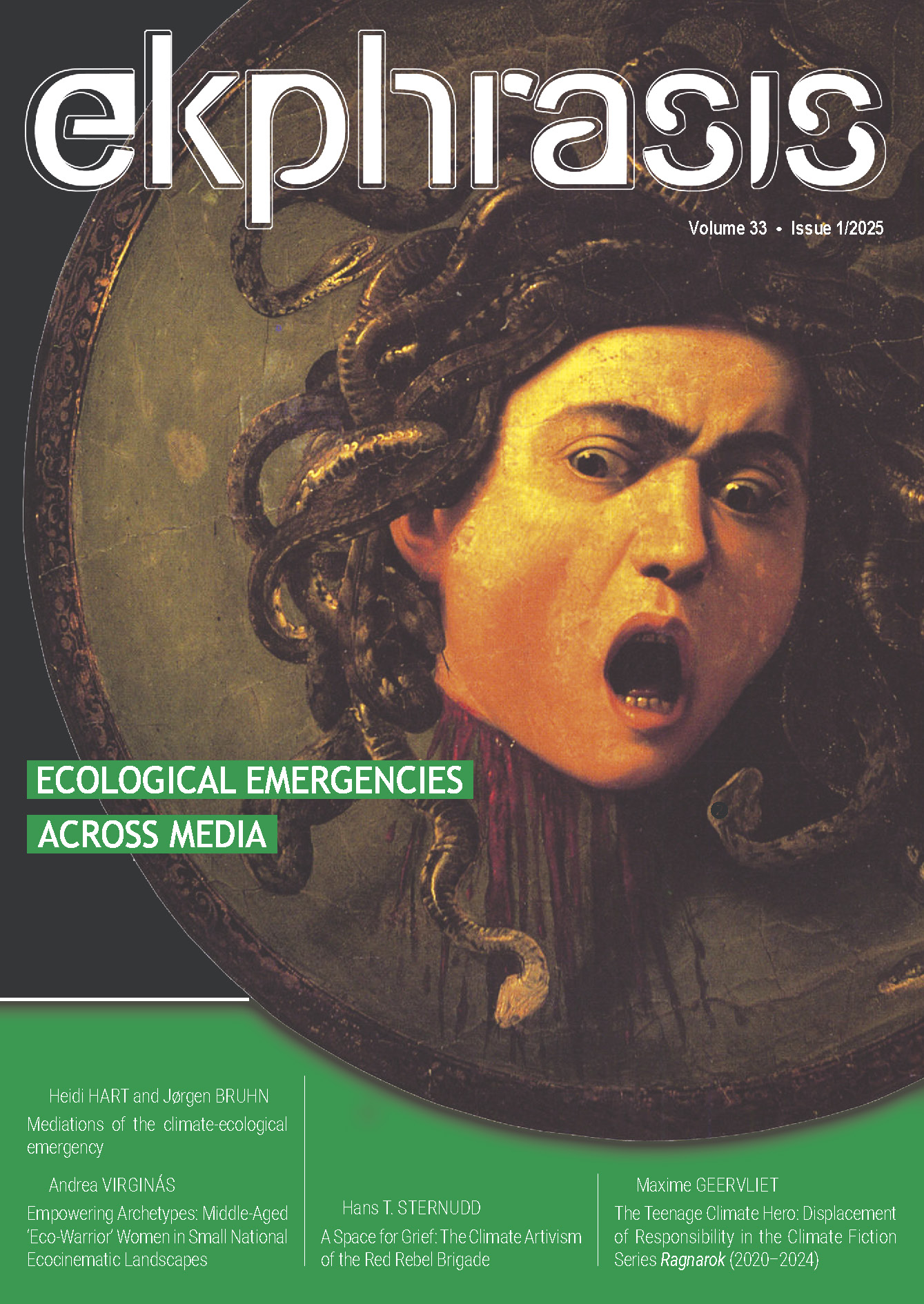
Vol. 33, Issue 1 / 2025
Topic: Ecological Emergencies Across Media
Coordinators: Heidi HART, Ola STÅHL and Jørgen BRUHN
Petr BUBENÍČEK
Abstract
This case study examines Jan Svěrák’s student film Ropáci (Oil Gobblers, 1988), highlighting the environmental destruction in Communist Czechoslovakia in the 1980s. Though initially low profile, Svěrák’s mockumentary eventually became a significant symbol of the Czech environmental movement, maintaining its influence even after the Velvet Revolution of 1989 and the fall of Communism. This study situates Oil Gobblers within its environmental and cultural context, analysing how it reflected, critiqued, and shaped the ecological consciousness. The paper aims to explore the film’s environmental themes, challenge anthropocentric assumptions, and link cultural production to broader ecological and cultural discourses. The study addresses two primary areas: first, broader environmental-cultural history, which, following Donald Worster, can be understood as the study of interactions between human societies and the nonhuman world (Worster 4). It will briefly overview the ecological devastation in northeastern Bohemia, the setting for Oil Gobblers. This analysis examines the creation and enduring significance of the mockumentary through the framework of intermedial ecocriticism, as developed by Jørgen Bruhn and Niklas Salmose (Inspired by but diverging in several ways from Bruhn and Salmose’s approach, Intermedial Ecocriticism is a new MA-level course, taught for the first time at Masaryk University by Petr Bubeníček and Tereza Dědinová in spring semester 2025. It explores the role of culture in the climate crisis, focusing on environmental justice, the green transition, and future visions of the biosphere. Through literature, film, visual arts, and new media, students examine how cultural forms shape ecological awareness. The course takes an interdisciplinary approach, drawing on ecocriticism, cognitive science, environmental psychology, and discourse analysis. Special emphasis is placed on the role of individuals in promoting sustainability and critically engaging with media and misinformation). This theoretical approach explores how different media forms represent and communicate ecological issues across diverse contexts. The selected mockumentary employs satire as a central strategy to critique environmental degradation. By integrating various media elements—such as humorous dialogue, parodic imagery, and mock-serious narration—the film constructs a layered engagement with ecological themes. Transmediation plays a crucial role in this process: the mockumentary adapts and reinterprets real-world environmental concerns, particularly the total destruction of natural ecosystems, into a satirical narrative form. We analyse how this adaptation reframes serious subject matter to provoke reflection through irony. As a cinematic text, Oil Gobblers exemplifies the intermedial relationship between film and ecological discourse. Through its distinctive audiovisual and narrative techniques, it highlights environmental destruction while situating it within broader cultural and ecological debates, thus challenging conventional representations of environmental crises.
Keywords: Mockumentary, environmental destruction, Intermedial Ecocriticism, satire, transmediation, Czech Environmental Movement
Liri CHAPELAN
Abstract
The present article has two main aims: on the one hand it intends to chart the emergence and the installation of an official ecological discourse in late socialist Romania – a discourse that is representative both for the growing wave of environmental concern that propagated across the Eastern Bloc and for the discursive strategies the socialist nations adopted in order to disculpate their civilizational stances and create an appropriate ideological frame for environmental preservation measures. After studying messages vehiculated principally through official press organs and defining the general cultural atmosphere that surrounded the fledgling national ecological consciousness, it will be argued that the production of the numerous amateur film clubs in activity in late socialist Romania offers an original vantage point to the issue of the type of imagery that was developed to echo the state-sanctioned ecological discourse. This will converge with the second aim of this article, which is to push amateur production into the sphere of interest of ecocritical media studies, while advocating for the necessity to adapt its methodologies to a type of material that is often poorly preserved, deprived of contextual information or even of parts of its content, and thus sometimes radically opaque. After focusing on a corpus of film club productions considered relevant for broad issues relating to representational paradigms of nature in the socialist context, the article will also scrutinize the early creations of materialist experimental film collective Kinema Ikon.
Keywords: late socialism, state-controlled ecological discourse, amateur film production, materialist experimental cinema
Stefano BRACCI TESTASECCA
Abstract
This article aims to analyse the narrativization of scientific truth claims and journalistic reports in the realm of non-fiction through an intermedial analysis of About a Mountain (2010) by John d’Agata, a text described by its author as a “lyric essay.” Loosely centered around the allocation of radioactive deposits inside of Yucca Mountain, not far from Las Vegas, but braided with numerous other stories, About a Mountain creatively strays away from the generic constraints of journalism through what this article identifies as the use of ‘ecstatic truth’ in order to create a ‘skewed path’ towards ecological agency. The lyric essay’s transmediation of factual and scientific truth claims into a more informal and literary medium for a wider public is also identifiable in The Lifespan of a Fact (2012), a companion book co-authored with d’Agata’s fact checker, Jim Fingal. Lifespan, an alleged record of their seven-years long conversation regarding the authenticity of the depiction of the facts dramatized in what would become About a Mountain, sheds light on d’Agata’s methods and biases and on the negotiations between the scientific discourse of journalism and the poetic discourse of creative nonfiction. An intermedial methodology, informed by narratology, genre studies, and ecocriticism, is used to identify the generic traits of the lyric essay as media affordances, paying particular attention to its use of truth claims and fictionality. Overall, this article seeks to identify the medium specificity of the lyric essay as a unique genre blending fiction and nonfiction, and hence its unique approach to environmental issues and ecological emergencies.
Keywords: Lyric essay, Eecstatic truth, intermedial Analysis, creative nonfiction, ecological agency, truth claims
Cecilia STRANDROTH
Abstract
This article examines the interplay of word and image in environmental communication through the lens of Swedish nature photography, focusing on the exhibition Vinnare och förlorare i svensk natur
(Winners and Losers in Swedish Nature) by the Swedish Association for Nature Photographers. The study contrasts this contemporary exhibition with Arne Schmitz’s 1977 photographic essay Landskap i förvandling (Landscapes in Transformation), highlighting divergent strategies in combining visual and textual elements to convey environmental messages. Drawing on W. J. T. Mitchell’s theories of image-text relations, the article critiques the exhibition’s reliance on aesthetically captivating close-ups of individual animals, which, while emotionally engaging, risk undermining the intended message about biodiversity and ecological interdependence. The accompanying texts, though informative, are often relegated to a secondary role, creating a dissonance between visual and verbal narratives. In contrast, Schmitz’s work exemplifies a more integrated and pedagogically effective approach, where images and texts mutually reinforce a critical environmental perspective. The article argues for a reconsideration of the conventional division of labor between image and word in environmental media, advocating for more cohesive strategies that align aesthetic appeal with ecological urgency.
Keywords: Environmental communication, nature photography, image-text relationship, biodiversity, visual rhetoric, documentary photography, media aesthetics
Andrea VIRGINÁS
Abstract
A three-section argumentation is advanced in order to unravel the functioning of the female eco-warrior stereotype in (Eastern) European, mostly small national cinematic creations working with/in the genre of eco-cinema. The aim is to prove its pertinence in mediating not only climate emergency, but also in reacting to challenges posed by the greying ageing of Europe – specifically that of women –, while circumscribing a position that is relatable to both what Sandra Harding describes as “feminist standpoint theory” (2004) and Martin Müller as “Global East” (2020). Infertility – be it articulated explicitly as a consequence of the female ageing process, or as instances of mysterious childlessness, of tragic miscarriage, of artificial fertilization or of adoption of even non-human beings – is the marker of the female heroines with a penchant for fighting bigger or smaller ecological wars in the examined 21 century feature films. According to their positioning in time these protagonists are entering middle age, or have passed to the second, non-reproductive part of the female life trajectory, and their complex, above-described linkages to actual, hypothetical, imaginary or symbolical offsprings constitute a powerful method by which to represent female existence modulated by the ageing process.
Keywords: Environmental communication, nature photography, image-text relationship, biodiversity, visual rhetoric, documentary photography, media aesthetics
Ajeesh A K and Rajesh HALAVATH
Abstract
Samanta Schweblin’s Fever Dream (Distancia de rescate, 2014, trans. 2017) presents a harrowing vision of ecological crisis through a deeply interior, disorienting, and sensorially immersive narrative. Avoiding the grand spectacle of climate catastrophe or the distanced realism of traditional environmental fiction, Schweblin instead offers a claustrophobic, affect-laden portrayal of slow violence, contamination, and maternal anxiety. Through its fragmented structure, second-person address, and atmosphere of dread, the novel transforms ecological emergency into a psychic and corporeal event, an embodied aesthetic experience that gestures toward intermediality. Drawing on the tonal registers of horror cinema, speculative fiction, sound art, and oral storytelling, Fever Dream unfolds as a toxic dreamscape where the boundaries between self and environment, human and nonhuman, become porous and unstable.
This paper positions Fever Dream as a work of intermedial ecological fiction, with its 2021 Netflix adaptation by Claudia Llosa functioning not merely as a narrative transposition but as an intermedial intensification of the novel’s eco-horror poetics. As such, the adaptation reveals what the novel can only suggest: the aesthetic entanglement of horror and ecology, dread and beauty. Both the novel and the film foreground feral ecologies, landscapes and bodies destabilized by agrochemical exposure, rendered ungovernable and mutagenic. These are not distant disasters, but intimate emergencies experienced through children, mothers, animals, and contaminated water. The Argentine countryside in Fever Dream is not a passive setting but an agent of mutation, producing hybrid life forms and altered perceptions. This paper argues that Fever Dream, in both its literary and cinematic expressions, radically reimagines environmental crisis as an aesthetic and affective entanglement. It refuses the redemptive arcs and explanatory frameworks typical of climate fiction and instead inhabits the terrain of spectral uncertainty, perceptual breakdown, and toxic intimacy. Environmental emergencies here are not narrated through spectacle but whispered in hallucinated fragments, buried in soil and breath, seeping slowly into the body and the screen alike.
Keywords: Environmental toxicity, Ecological trauma, Slow violence, Contamination, Narrative fragmentation, Ecological grief
Silvia KURR
Abstract
If in antiquity the term ekphrasis was used to denote a speech that stimulates mental visualization,
then in contemporary discourse, ekphrasis refers to a wide array of intermedial phenomena, from descriptions of paintings and sculpture to the integration of film, photography, and digital media in literary works. Evolving in a time of environmental emergencies, contemporary ekphrastic writing often engages with various media products that address the environmental crisis, such as ecological artworks, television footage of environmental disasters as well as painterly, photographic, and digital images of the Anthropocene. As Gabriele Rippl observes, ekphrasis can invite the reader to engage with ecological issues and “conceive of the human-nature relationship in a new non-anthropocentric way” (“Sustainability” 221). Rippl then introduces the term “eco-ekphrasis,” thereby bringing together considerations of intermediality and ecology in literature (“Sustainability” 225). My approach to eco-ekphrasis is informed by new materialist thought, which
aims to challenge the anthropocentric idea of human mastery over the material world. Taking as case studies Richard Powers’s novels The Overstory (2018) and Bewilderment (2021), this essay explores how eco-ekphrasis can draw attention to large-scale ecological processes and the effects of the Anthropocene, while simultaneously cultivating a sense of embodied, material embeddedness in the more-than-human world.
Keywords: ekphrasis, intermediality, new materialisms, arboreal time, Anthropocene, Richard Powers
Signe KJÆR JENSEN
Abstract
“Mankind is not vicious, mankind is stupid. Someday man will realize what he’s doing. By killing everything in the sea he is killing himself. When the sea is dead, mankind will die, too” (Hastrup, Samson and Sally, 55.30–55.45). These words, spoken by the old whale Moby Dick in the Danish animated film Samson and Sally from 1984, echo the ecological lament found in Bent Haller’s source novel, Kaskelotternes sang [The Song of the Sperm Whales, my translation]. In the novel, Moby Dick contrasts humanity’s inclination to “destroy and kill and be lonely” with the whales’ choice to “live well and happy together, play and sing” (Haller, 97, my translation). Both the film and the novel convey a powerful ecocritical message, subverting the anthropocentric perspective of Moby Dick and fostering sympathy for the hunted whales. In their depiction of multiple human-made and systemic threats towards “everything in the sea”, the two media products effectively pre-empts the idea of a global ecological emergency, warning against the mass extinction of species and the loss of vital ecosystems.
In this essay, I will examine how the film and the novel represent this looming ecological emergency and construct an eco-centric worldview through two interrelated strands. First, I will demonstrate how these different media products guide audience sympathies towards non-human subjects, which can be argued to be a key aspect in learning to recognize, acknowledge and act upon ecological emergencies. Second, I will investigate the role of intermedial references. In addition to references to the classic novel Moby Dick, or, the Whale (Melville), the film even alludes to Noah’s Ark, the sinking of the Titanic, and the dumping of radioactive waste. These kinds of references work to underscore humanity’s vulnerability and their impact on, and responsibility towards, the natural environment, highlighting the relevance of an intermedial framework in understanding the communication and mediation of ecological issues.
Keywords: transmediation, animation, children, ecocriticism, ecological emergency
Andreas JAHREHORN ÖNNERFORS and Annette MARS
Abstract
Ecomedia studies often align with ecocritical activism, portraying environmental themes and advocating for climate justice. However, this chapter investigates a contrasting phenomenon: the emergence of a ‘dark side’ of ecomedia – cultural expressions that obstruct climate action through denial, delay, and inaction. The study explores how ecomedia can be mobilized for uncivil ends, challenging normative assumptions about civil society’s role in promoting sustainability. It focuses on the Swedish doom metal band Wardenclyffe and its frontman Jacob Nordangård, whose work reimagines the UN Sustainable Development Goals (SDGs) as instruments of global control. Drawing on civil society theory and transmedia storytelling, the chapter conducts a deep intermedial and transmedial analysis of the song and music video Georgia Guidestones/Evilution (2021). This includes decoding lyrics, musical composition, visual aesthetics, and narrative strategies. The analysis reveals a coherent conspiratorial narrative that inverts the SDGs into symbols of oppression. Through a synthesis of sound, text, and image, Wardenclyffe constructs a dystopian vision in which climate change is portrayed as a fabricated threat and sustainability as a tool for authoritarian control. The study suggests that conspiracy-driven ecomedia can generate what we term ‘conspiratorial affect,’ using artistic expression to foster distrust in climate initiatives. While the analysis is limited to a single case study, it opens avenues for examining similar patterns in other cultural artifacts. This chapter contributes to the emerging discourse on cultural climate obstruction, urging future research to further investigate how artistic media may serve not only as tools for ecological advocacy but also as platforms for resistance to and obstruction of environmental action.
Keywords: dark ecomedia, conspiratorial affect, Sustainable Development Goals (SDGs), doom metal, conspiracy theories
Hans T. STERNUDD
Abstract
This article examines performances by the climate artivist group Red Rebel Brigade, who appear at climate change demonstrations in full-body red costumes and perform in silence and slow motion. The performances aim to “embody the grief of the Earth” by creating an emotional space. Apart from analysing the Red Rebels’ performances, this article also discusses whether the concept of grief is useful in climate mobilisations. The Red Rebel Brigade is seen as a manifestation of post-apocalyptic environmentalism — an activism that acknowledges that the climate catastrophe has already occurred. The article examines this concept using an intermedial framework and a space-place theory. Space is understood as a category that is created relationally between people and places, as well as between people. Content analysis was used to analyse material consisting of YouTube videos of manifestations relating to COP26 in Glasgow in 2021 and A Funeral for Nature in Bath in 2024. The analysis yielded four types of relational spaces through the Red Rebel’s relationships with the environment, other people, the mass media, and other media. The results showed that, during the COP26 performance, the Red Rebels focused strongly on creating striking images for mass media. However, it seemed that they did not engage with or make sense to bystanders. By contrast, the use of a funeral theme in the Bath action seemed more intelligible to those not involved in the performance, making it easier for them to engage with it. Lastly, the question of whether grief can be fruitful in climate activism is addressed. One problem with grief is that, if it is fruitful, it leads to acceptance rather than action, Consequently, mobilisations focused on climate change may be better served by emotions such as fear, panic and anger.
Keywords: Grief, artivism, climate activism, post-apocalyptic environmentalism, Red Rebel Brigade, intermediality, space
Heidi HART
Abstract
This curatorial essay describes Odd Johan Fritzøe’s multimodal dance work Adventura Botanica, performed by Elisabeth Christine Holth at the 2023 Environmental Emergencies Across Media conference in Kalmar, Sweden. Using dance, sculpture, movement-activated lighting design, and improvisation-based music by the SPUNK group, this work mediates ecological themes in complex and yet approachable and even sometimes humorous ways. Though initially inspired by Darwin’s interest in multispecies pollination, Adventura Botanica offers numerous imaginative entry points for the audience. The process of preparing the space and the sculpture, the performance itself, and the energetic, curious responses of the audience created a nexus of embodied engagement with the conference’s theme. This chapter describes both the production’s overlapping intermedial layers and the phenomenon of critical vulnerability in reception, drawing on Lars Elleström’s intermedial theory and recent posthumanist approaches including Christine Daigle’s. A human body enacting nonhuman life processes does not necessarily come across as glib anthropocentrism but rather opens up a space for imagining other bodies and vulnerabilities on a threatened planet.
Keywords: dance, intermediality, curatorial practice, environmental art
Miriam de PAIVA VIEIRA
Abstract
The present study engages with the pressing environmental crisis by examining how Confinada (2020–2021), a Brazilian webcomic, contributes to critical ecocriticism, particularly through multimodal and intermedial strategies. As environmental degradation disproportionately affects marginalized populations in Brazil, particularly in non-planned urban spaces like favelas, the concept of environmental racism (Chavis) becomes essential for understanding these asymmetries. The aim of this paper is to investigate how architectural and urban elements diagrammatically represented in the narrative multimodal layers of Confinada evoke traces of Brazil’s colonial past while exposing the structural inequalities that persist in contemporary urban policies. Methodologically, the study draws from intermedial ecocriticism and (multi)modality studies (Elleström; Bruhn; Gibbons; Jensen), combining them with theoretical frameworks from environmental racism (Chavis). The analysis focuses on selected panels of the comic that emphasize spatial segregation, environmental vulnerability, and everyday resistance.
Findings suggest that Confinada constructs a critical visual narrative that challenges representations of urban modernity and exposes how environmental precarity is racialized. The use of intermedial layers—visual, textual, spatial—becomes a powerful means of articulating socio-environmental critique from a marginalized perspective. While this study offers insights into a specific Brazilian context, its scope is limited by the focus on a single case study. Nevertheless, it opens pathways for further research on the role of graphic narratives and digital media in shaping decolonial ecocritical discourse.
Keywords: environmental racism; intermediality; multimodality; architecture; Confinada
Maxime GEERVLIET
Abstract
This paper examines the Netflix series Ragnarok (2020–2024) through the lens of intermedial ecocriticism, focusing on the construction and implications of the “Teenage Climate Hero” trope. Drawing on Linda Haverty Rugg’s theory of environmental guilt displacement and the intermedial framework of Niklas Salmose and Jørgen Bruhn, the study argues that Ragnarok displaces the responsibility for addressing the climate crisis onto adolescents, despite clearly identifying corporate and governmental actors as the primary culprits. By transmediating real-world ecological emergencies and youth climate activism—particularly as represented in the documentary Make the World Greta Again—into a mythological YA superhero narrative, the series both empowers and burdens its young protagonists. The paper explores how the series’ narrative and visual strategies, including the use of Norse mythology and superhero tropes, obscure this displacement by framing environmental resistance as a heroic, individualistic quest. Ultimately, the series undermines its ecological message by concluding with a metafictional twist that renders the entire climate battle imaginary, thereby neutralizing the agency of its young heroes and reinforcing the problematic rhetoric that future generations alone must solve the climate crisis.
Keywords: Teenage Climate Hero, displacement of responsibility, Intermedial Ecocriticism, Climate Fiction (Cli-Fi), youth activism, transmediation, environmental guilt
Adela NEGUSTOR
Abstract
This paper explores how J.G. Ballard’s The Drowned World is reimagined through intermedial ecocriticism and McKenzie Wark’s concept of low theory in the context of the Toronto Biennial of Art’s Cinesphere. Curated by Charles Stankievech, the exhibition brought together 24 artists whose works reinterpreted Ballard’s speculative vision through film, digital simulation, sonic composition, and archival media. Works such as Stankievech’s Cargo Coral (Espiritu Santo), Lisa Rave’s Europium, Drexciya’s Bubble Metropolis (1993), Cyprien Gaillard’s Ocean II Ocean, and Brandon Poole’s Carla’s Island investigate climate crisis, colonial residue, and techno-scientific mediation. By analyzing how these intermedial works engage audiences through layered media forms, this paper argues that such practices are not simply aesthetic but also tactical. They destabilize hegemonic narratives of progress and environmental catastrophe, functioning as “low theory” interventions that foreground submerged histories, critique techno-scientific rationalities, and propose speculative futures. Drawing from Afrofuturism, media archaeology, and the sensory politics of sound and space, these artworks reveal the climate crisis as both material and mediated. Intermedial strategies—archival remix, sonic myth-making, and cinematic temporal collapse—serve as tools to subvert dominant epistemologies and reconfigure the relationships between ecology, history, and media. These adaptations do not merely visualize ecological transformation; they embody and spatialize it, engaging audiences in affective, multisensory ways. As artificial islands and aquatic architectures become speculative spaces for negotiating climate anxiety and terrestrial precarity, intermedial art emerges as a critical method of reworlding. Ultimately, this paper contends that media are not only vehicles of representation but also historical agents. Through the lens of Ballard’s drowned landscapes, these artists articulate new relations between past and future, memory and matter—where intermediality becomes a necessary practice for navigating ecological uncertainty and reshaping planetary imaginaries.
Keywords: low-theory, homo aquaticus, aquatocene, dome, Afrofuturism
Kricie Ann JONSSON
Abstract
This essay presents an intermedial ecocritical analysis of the mural Manifest Destiny and the metroidvania video game The Aquatic Adventure of the Last Human. It examines these two distinct media products as disanthropic narratives by comparing how they mediate the themes of human extinction and nature’s reclamation. The study also considers the kinds of ecological reflections these works may elicit from their audience and the means by which they do so. The analysis reveals how the mediation is facilitated and shaped by each medium’s specific affordances and genre conventions. Furthermore, the study uncovers similarities in affective tone and reflective impact, contributing to both the discussion of ecomedia and ecological agency, and the theorization of disanthropy as a distinctive narrative mode within the broader landscape of eco-speculative storytelling.
Keywords: disanthropy, disanthropic narratives, climate change, intermedial ecocriticism, submergence, mural, metroidvania, Manifest Destiny, The Aquatic Adventure of the Last Human
Malin LÖF NYQVIST
Abstract
Flooding is a major factor in current and future environmental emergencies caused by anthropogenic climate change—for example in the form of rising sea levels or extreme weather events. The flood is also one of the most culturally recognizable and relatable tropes through which climate change has been mediated in Western literature and film for the last half century (Trexler 2015). Flooding, real or fictional, exposes the ambivalence of humanity’s relationship with water, and serves as a reminder of the dynamic nature of our surrounding landscapes. Contemporary flood fiction, whether in the form of literature, film or TV, tends to depict and address questions of place, place attachment and change, which are highly relevant to understanding the emergencies facing the more-than-human world in the Anthropocene. In this article, I examine one specific aspect of this tendency: the function of the non-authorial, extradiegetic map in contemporary flood fiction.
Using a discussion about how to understand the inclusion of visual maps in literary fiction in relation to the concepts of paratext, imagetext and illustration as a point of departure, I examine the relationship between the visual map and literary narrative in two Swedish flood novels. I question what role these maps play in the mediation of environmental disasters or climate change, especially in relation to genre, the spatiality of the novels’ storyworlds, and the interplay between image and text, and suggest some further explorations on this topic where interdisciplinary efforts combining intermedial and literary studies might be especially fruitful.
Keywords: flood fiction, climate change fiction, disaster fiction, fictional maps, literary maps, paratext, imagetext