
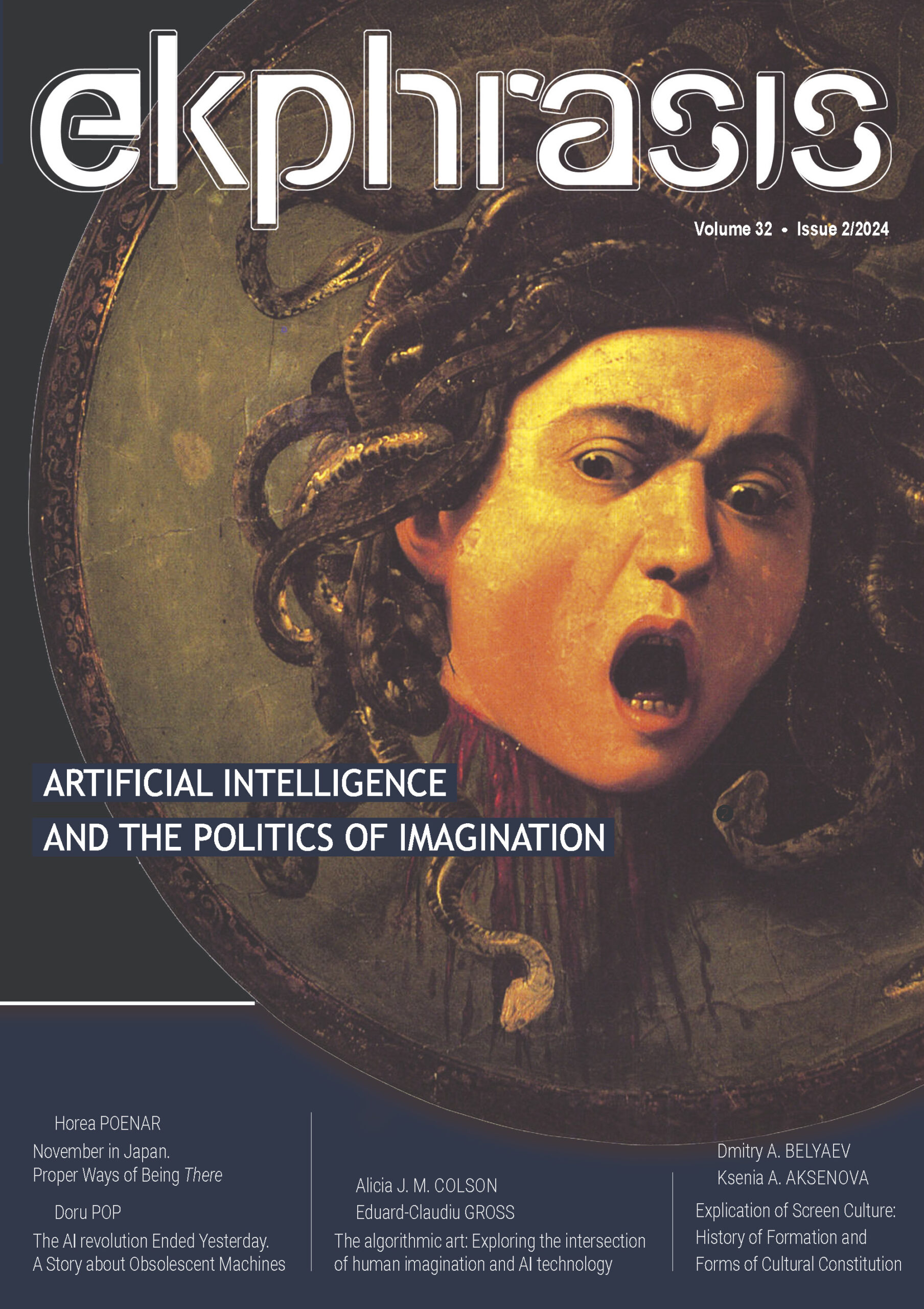
Vol. 32, Issue 2 / 2024
Topic: Artificial Intelligence and the Politics of Imagination
Coordinators: Horea POENAR
Doru POP
Abstract
Manifested as an attractive science fiction trope, the fear that artificial intelligence is going to be at war with homo sapiens, that human beings might be replaced by their own creations, are cultural anxieties amplifed by the technologies of the new millennium, with various autonomous systems driven by AI taking over our lives. Artificial intelligence seems to be everywhere, apparently changing humanity and even evolution. Overviewing three recent productions, Atlas (2024), The Creator (2023) and The Beast (2023), used as examples for showcasing a different approaches to problems related to machine intelligence, military power, political systems and human emotions, this contribution explores the various possible expressions of our deep distrust towards intelligent machines. Using a version of Deleuze and Guattari’s “nomadology”, the author proposes a NOMAD(ID)eological interpretation, a distinct methodological approach dealing with “nomadic” transformations of the future of mankind. As indicated by the evolution of the cinematic machine patented by the Lumière brothers in 1864, we must observe that there is an inherent technological plateau for all human technologies. After 160 years existence, we are basically using the same cinema apparatus and, just as the “cinematographic revolution” faded from its very invention, the author suggests that the “AI revolution” has simultaneously reached its peak and utter end. The conclusion of this contribution, based on the theory of stagnation, remains that our fears about AI are based on the false premise that this new technology will result in an unexpected outcome. Using the comparison with the cinematic machine, AI technologies have reached their evolution potential from the very moment they were created, they are capable of endlessly generating parrot-like texts, allowing us to create funny images and videos, amusing us with their mimetic potential and incessantly calculating data that humans have created in the past.
Keywords: Nomadology, Artificial intelligence, technological stagnation, techno-anxieties, cyberfeminism, science fiction films, Atlas (2024), The Creator (2023), The Beast (2023)
Alicia J. M. COLSON, Eduard-Claudiu GROSS
Abstract
Today, many people perceive that algorithmic art is the result of recent innovations. The key word here is ‘perceive’ as neither Frieder Nake (born 1938) nor Harold Cohen (1928–2016), the pioneers of algorithmic art, are rarely mentioned within the current epistemic context. Nake’s first public contribution to computer art was in three exhibitions in 1965. Obviously, Nake’s and Cohen’s roles are fundamental, and their contributions must be considered in any discussion seeking to understand the role of human imagination in algorithmic creation. The present paper aims to address the human role in the creation of art by means of generative artificial intelligence. The creative sector appears to be gradually embracing AI-generated content as one of many categories of images, but it is clear that the worldviews of those involved have consequences on both the AI tools created and the outcome as ‘art’. The complex relationship between algorithmic autonomy and human agency is discussed in order to establish any underlying power dynamics and disparities in the technological environment of the ‘art’ world. This discussion utilizes the case study approach so to examine current applications of AI in creative campaigns in order to provide real-world examples and empirical data.
Keywords: Generative AI, Authorship, Human-machine synergy, Human Imagination, Creativity
The Ambivalence of Imagining the “OUTSIDE”: On Nick Land’s Libidinal Materialism
Mihai ȚAPU
Abstract
This paper seeks to offer a critical assessment of Nick Land’s early writings in light of his views on “libidinal materialism”. Being a relatively niche figure in the 1990s and 2000s, Nick Land rose to prominence in the 2010s due to the publication of his collected writings as Fanged Noumena, in 2011, which revealed him as one of the forerunners of accelerationism, an ambivalent political theory which promoted the need to accelerate “through” (rather than “against”) the elements of capitalism in order to reach a “post-capitalist” future. The aim of this paper is to shed light on an earlier concept developed by Land in his first book, The Thirst for Annihilation, that of “libidinal materialism”. Although Land’s popularity, both in popular culture and in academic discussions, has slowly grown in the last decade, most of the analyses concerning his philosophy revolve around his specific form of Deleuzo-Guattarian-infused “accelerationism”, marginalizing his initial interest in Georges Bataille, the central figure of Thirst for Annihilation. Thus, the present paper attempts to analyze, through a close reading of Land’s first book, some of the author’s first philosophical explorations, such as his discontents with the style of academic philosophical writing, his rejection of Kantian transcendentalism in favor of Bataillean “expenditure” and his first original concept, “libidinal materialism”. Throughout this exploration, what stands out the most is Land’s relentless criticism of Kantian philosophy and his efforts to construct an alternative to the post-Kantian tradition in continental philosophy.
Keywords: Nick Land, Georges Bataille, base matter, expenditure, transcendental idealism, death drive, libidinal materialism
Dmitry A. BELYAEV, Ksenia A. AKSENOVA
Abstract
The screen is rapidly becoming the dominant mode of modern culture, acting as a technological tool, a medium and a special, in its own way unique environment for the multidimensional human existence. This actualizes the study of the genesis of screen culture, the content and evolution of the formats of its representation both in the structure of human everyday life and in the historical continuum of culture.
The research methods include the following: the methodology of evolutionism, cultural-semiotic and comparative methods, which allows to trace the genesis of screenness and compare various forms of screen culture; and the typological method and systematic approach, which allowed to systematize the forms of screen culture and reveal the principles of their distinction.
The paper identifies four main screen formats: cinematographic, television, computer and smartphone-mobile. The acceleration of the screening dynamics of many cultural spheres and the formation of a special cultural continuum will be revealed, where all traditional social and personal activities are screened, creating a space of new authenticity and mythology. The framework of its architectonics is visually dynamic forms, often with interactive and hypertextual properties. At the same time, screen rhetoric is based more on visual images and clip-editing techniques for presenting information, which leads to an emphasis on emotional-affective rather than rational-logical perception.
The authors concluded that many sociocultural practices are transferred to the screen format, contributing to the formation of a new dominant modality of human existence as a screen Homo Digital. The explication of the genesis of electronic screenness allows us to understand the structure of the screen reality of modern culture and build effective strategies for predicting its dynamics in the future.
Keywords: screen culture, cinema, television, computer, smartphone, interactivity, screen medium, digital man
Horaţiu CURUŢIU and Ion INDOLEAN
Abstract
In the logic of computer-generated worlds, this article proposes a look at films in which the protagonists try to overcome a tribulation or challenge by systematically returning to the past, moving not only in space but also in time. This can be seen as unreliable narration, as the viewer cannot predict what will happen next, since the scripts of these films work in a logic of their own, defying the dynamics of a classic narrative. Source Code (Duncan Jones, 2011), Edge of Tomorrow (Doug Liman, 2014), and Tenet (Christopher Nolan, 2020) present stories that rely on this medium’s ability to play with space and time for their very appeal, being similar in many ways to video games. To better understand all mental processes spectators undergo while watching this kind of stories, we look at how they use narrative conventions to create the feeling of a video game where space and time can be collapsed into one, and where boundaries are pushed for greater freedom. At the same time, within just a decade (2010s), we can identify an important evolution of this type of cinema, which automatically entails a development of the degree of narrative complexity and of its own rules that audiences are able to grasp. Source Code repeats a short period—8 minutes; Edge of Tomorrow spans several hours—about a day; and Tenet wanders through several days, back and forth, denying the protagonist a chance to repeat an event if he is killed, but giving him the opportunity to return in the midst of defining moments for the success of his mission.
Keywords: Sci-fi cinema, unreliable narration, time travel, video game logic
Evangelos NIFORATOS, Bruce FERWERDA, Mira POP, Max SCHRICKER
Abstract
With just a few words, designers can invoke text-to-image AI tools to generate relevant images that jump-start the creative process. These images are computationally generated to approximate everyday-life physical or digital products, such as a coffee machine or a sports website, and thus can aid collaborative design. But how do generative AI tools influence the User Experience (UX) design process, and do they improve product UX after all? This paper investigates the integration of generative AI in the UX design process in the context of mobile application design. We organized two distinct design workshops where eight designers in total (1) used no AI, or (2) the Midjourney AI tool, to design two high-fidelity mobile app prototypes. We evaluated both prototypes with 32 participants in a user study. Our results indicate that AI influences the UX design process in a differential way but it does not necessarily lead to superior UX quality.
Keywords: Artificial Intelligence, user experience, generative AI, AI design, digital products, mobile applications
Laura T. ILEA
Abstract
The article tackles the relationship between the way we represent ourselves in the social network and the old Platonic problem of representation, as it was highlighted in Mihnea Măruță’s book, Virtual Identity. Why and How are We Transformed by the Social Media, 2023. Drawing on the idea that the seduction of the social network comes from the illusion of centrality and power, the book equally reiterates the threat of freedom it involves. Pondering on arguments highlighted by Horea Poenar and Érik Bordeleau in a dialogue published in the volume Inflexiuni, 2022, as well as on the symbolic fault lines explored by writers such as Nancy Huston, Ingeborg Bachmann, and Elena Ferrante, the article proves that the creative multilayers of natural languages, involving “untranslatable” resources for truth, care, and justice, should not be leveled down to the translational achievements of a powerful engine. Moreover, the “perforating language” invoked by Achille Mbembe, which is meant to create a “terrestrial community,” should be able to express the scale of infinite probabilities on which information is performed nowadays, in a more creative way.
Keywords: social network, virtual identity, Platonic theory of representation, translation, terrestrial community, information, natural languages, creativity
Călina PĂRĂU
Abstract
The present paper aims to investigate world literature’s struggle for finding an imaginary way out of the hegemonic logic of neoliberal capitalism, the standardization of global narratives, and the commodification of local realities. We will delve into the cultural relation between imagination and collective memory in order to investigate how fictionalization negotiates the accessibility of the past, retaining or dismissing unassimilable memories and representations. The paper will draw on the compelling case of Lebanese writer Elias Khoury, who worked with the fragments of the stories he gathered from a Palestinian refugee camp, during the 1948 Arab-Istraeli war, in two of his major novels, Bāb al-Shams (Gate of the Sun, 1998) and Awlād al-Ghītū—Ismī Ādam (Children of the Ghetto—My Name is Adam, 2016). What these novels have in common is a fascination with the role of narrative imagination/storytelling within the dynamics of fractured representational relations on the global stage. Thus, I seek to look into the ways in which transnational imagination integrates or translates historical disruption or experiences of displacement. I am interested in the mechanisms employed by these works of fiction that shed light on how the ‘local’ becomes comprehensible through universalizing frames or on how the local functions as a spectre within this trans-cultural imaginary. The general aim is to see whether these contexts in which our relation to the story of the victim is constructed through the prevalence of imagination over memory discourses or historical narratives can foster a sense of international solidarity.
Keywords: imagination, world-system, displacement, translation, narrative, silence, history, fiction
Amit MANDAL
Abstract
The narrative dynamics of HBO’s Westworld pivots around the question of biological embodiment
and the hard problems of consciousness. Death does not only mean the end of body but also consciousness itself. But the link between brain/mind and its generative aspects for consciousness is breached in strictly representing consciousness via codes or algorithms—programmable and replicable, that may not always emanate from the dynamics of the brain/mind itself. Consciousness can be replicated into codes to create more human-like Hosts. This leads to the possibility of copy-pasting human consciousness in human-like robots to create a temporal continuity of human species defying death and mortality. Here, Westworld exercises transhumanist thinking about human existence and mortality by challenging our evolutionary programming and directives. It also includes robot ethics and theory of consciousness as main issues.
The paper investigates transhumanist imaginings regarding post-death experiences and its impacts upon theories of transcendence and immortality via Westworld. The very fact of re-presenting post-death experiences is bound to be a subjective perspective, thereby challenging objective methods of critically analysing such supposed ‘phenomenology’ or quantifying the same. The paper shall attempt to problematize the teleological stance of human embodiment in Westworld in favour of imagining a transcendental-embodied self by applying a transhumanist way of thinking.
Keywords: telos, transhumanism, consciousness, embodiment, immortality
Horea POENAR
Abstract
The following paper analyzes the ways in which imagination is a key mechanism in defining the concept of identity (of a persona or of the other). It does so by articulating two concrete experiences of Europeans visiting Japan: the literary theorist Roland Barthes in 1966 and the jazz pianist Keith Jarrett in 1976. Both cases are relevant and symptomatic not only for those historical periods, but also for essential contemporary debates concerning cultural appropriation, multiculturalism and the perspectives through which we encounter, comprehend, and behave towards alterity. Several more theoretical dimensions are revisited, from Martin Heidegger’s rooting of the sense of Being in a precise here and now to ethical considerations on what constitues an Event (and not only an aesthetic one) and to the way music can teach us different nuances for redefining contemporary theory in connection to today’s most urgent needs.
Keywords: imagination, alterity, identity, music, ethics, axonometry
Ruxandra CESEREANU
Abstract
This essay speculates on the nuances of communication between the human being and artificial intelligences or artificial intercommunication, trying to show what are the chances, problematizations or adaptations that the future will challenge us, as a human species engaged in the progress of extreme technology. In this sense, various research laboratories are presented, which have the visionary ambition to propose a positive solution in the relationship between man and Machines.
Keywords: posthumanism, artificial intelligence, communication, fake people, Machines, Lingodroids, Star Wars, Westworld, Merlin Project, CETI Project, physical intelligence, liquid networks